
A Malaysian-developed DNA cancer vaccine candidate designed to help the immune system recognise and fight cancer cells expressing MAGED4B and FJX1.
A Malaysian-developed DNA cancer vaccine candidate designed to help the immune system recognise and fight cancer cells expressing MAGED4B and FJX1.
Lung cancer remains one of the most urgent cancer challenges globally
and in Malaysia. Despite advances in immunotherapy
and chemotherapy combinations, many patients still do not respond adequately,
highlighting the need for new treatment approaches.
Lung cancer remains one of the most urgent cancer challenges globally and in Malaysia. Despite advances in immunotherapy and chemotherapy combinations, many patients still do not respond adequately, highlighting the need for new treatment approaches.
Lung cancer is a major global cancer burden. Asia accounts for approximately 63% of global incidence and mortality. In Malaysia, lung cancer is the No. 1 cancer by mortality rate.
Current neoadjuvant options include nivolumab and pembrolizumab combinations. However, best-practice protocols achieve around a 35% response rate, creating space for next-generation immunotherapy.
Personalised cancer vaccine approaches can be time-consuming and costly. Targeting tumour-associated antigens supports a more scalable, off-the-shelf approach for a wider patient population.
Lung cancer is a major global cancer burden. Asia accounts for approximately 63% of global incidence and mortality. In Malaysia, lung cancer is the No. 1 cancer by mortality rate.
Current neoadjuvant options include nivolumab and pembrolizumab combinations. However, best-practice protocols achieve around a 35% response rate, creating space for next-generation immunotherapy.
Personalised cancer vaccine approaches can be time-consuming and costly. Targeting tumour-associated antigens supports a more scalable, off-the-shelf approach for a wider patient population.
CRMY-VAC-100 is a DNA cancer vaccine candidate that targets MAGED4B and FJX1, two cancer-associated antigen proteins. It is designed to stimulate cancer-targeting T cells and support stronger anti-tumour immune responses, particularly when combined with checkpoint blockade therapy.
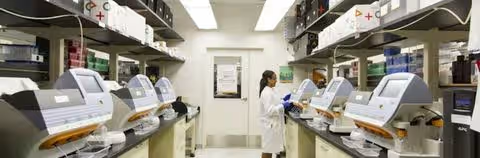
Built on proprietary dbDNA™ technology, this non-plasmid, cell-free manufacturing platform enables faster, highly scalable, and cost-efficient production, developed from Cancer Research Malaysia’s long-running immunotherapy research programme.


CRMY-VAC-100 focuses on MAGED4B and FJX1. These cancer-associated antigens were found to be frequently expressed in tumour samples, specifically co-expressed in 43 out of 44 tested HNSCC samples.
Positioned as a cell-free, fast, and highly scalable platform. It eliminates extraneous plasmid sequences and antibiotic resistance genes, ensuring greater cost efficiency and manufacturing speed.
MAGED4B and FJX1 are expressed by approximately 90% of lung cancer samples. Published data notes co-expression across non-small cell lung cancer, supporting relevance well beyond head and neck cancer.
Preclinical data showed stronger tumour control when combined with anti-PD1 therapy. Achieved 97% tumour growth inhibition for the vaccine + anti-PD1 combination, compared to 60% for anti-PD1 alone.
CRMY-VAC-100 focuses on MAGED4B and FJX1. These cancer-associated antigens were found to be frequently expressed in tumour samples, specifically co-expressed in 43 out of 44 tested HNSCC samples.
Positioned as a cell-free, fast, and highly scalable platform. It eliminates extraneous plasmid sequences and antibiotic resistance genes, ensuring greater cost efficiency and manufacturing speed.
MAGED4B and FJX1 are expressed by approximately 90% of lung cancer samples. Published data notes co-expression across non-small cell lung cancer, supporting relevance well beyond head and neck cancer.
Preclinical data showed stronger tumour control when combined with anti-PD1 therapy. Achieved 97% tumour growth inhibition for the vaccine + anti-PD1 combination, compared to 60% for anti-PD1 alone.
Over a decade of rigorous scientific advancement, moving from foundational antigen
discovery to generating a next-generation DNA vaccine candidate.
Over a decade of rigorous scientific advancement, moving from foundational antigen discovery to generating a next-generation DNA vaccine candidate.
Initiated the development of tumour antigen-derived peptide vaccines. Successfully identified important cancer antigens that are immunogenic in HNSCC patients.
Evaluated the anti-tumour activities of antigen-derived peptides in syngeneic models. Early peptide vaccine work demonstrated delayed tumour growth in animal models.
Conducted preclinical evaluation showing that the peptide vaccine was safe, with thorough assessments referencing kidney, heart, spleen, and liver panels.
Generated a second-generation cancer vaccine in DNA form. Groundbreaking preclinical models showed that the combination of the DNA vaccine and an anti-PD1 antibody halted tumour growth.
Ongoing expansion focusing on enhanced antigen presentation. Demonstrated delayed tumour growth and synergistic performance with checkpoint blockade in liver cancer, and prevented recurrence in lung cancer models.
MAGED4B and FJX1 were frequently expressed in HNSCC tumour samples, with 43 out of 44 tested samples co-expressing both targeted antigens.
DNA vaccines targeting MAGED4B and FJX1 induced powerful antigen-specific T-cell responses and significantly increased T-cell infiltration into tumours.

Studies describe the vaccine's potential to convert immunologically cold tumours into hot tumours, directly linked to increased CD8+ T-cell infiltration.

The DNA vaccine enhanced the efficacy of anti-PD1 therapy in preclinical settings, reporting complete tumour elimination or static growth in the majority of subjects.

MAGED4B and FJX1 were frequently expressed in HNSCC tumour samples, with 43 out of 44 tested samples co-expressing both targeted antigens.
DNA vaccines targeting MAGED4B and FJX1 induced powerful antigen-specific T-cell responses and significantly increased T-cell infiltration into tumours.
Studies describe the vaccine's potential to convert immunologically cold tumours into hot tumours, directly linked to increased CD8+ T-cell infiltration.
The DNA vaccine enhanced the efficacy of anti-PD1 therapy in preclinical settings, reporting complete tumour elimination or static growth in the majority of subjects.
Creating clear pathways from the laboratory to large-scale clinical manufacturing.
Creating clear pathways from the laboratory to large-scale clinical manufacturing.
Positioned as a first-in-class, first-in-human cancer vaccine candidate from Malaysia, targeting MAGED4B and FJX1 for advanced oncology treatments.
The dbDNA™ platform is positioned as potentially competitive with mRNA cancer vaccines, leveraging inherent advantages in lower production costs and superior stability profiles.
We are advancing novel cancer therapy targets with a clear roadmap toward clinical utility, regulatory engagement, and market readiness.
Strategic potential for local CDMO capabilities, advancing biosecurity, capacity building, high-value job creation, and future export potential.
Positioned as a first-in-class, first-in-human cancer vaccine candidate from Malaysia, targeting MAGED4B and FJX1 for advanced oncology treatments.
The dbDNA™ platform is positioned as potentially competitive with mRNA cancer vaccines, leveraging inherent advantages in lower production costs and superior stability profiles.
We are advancing novel cancer therapy targets with a clear roadmap toward clinical utility, regulatory engagement, and market readiness.
Strategic potential for local CDMO capabilities, advancing biosecurity, capacity building, high-value job creation, and future export potential.
CRMY-VAC-100 is being positioned with a long-term indication strategy. Beginning with lung cancer, the platform shows strategic direction for expanding into other cancers where MAGED4B and FJX1 are highly relevant.
CRMY-VAC-100 is being positioned with a long-term indication strategy.
Beginning with lung cancer, the platform shows strategic direction
for expanding into other cancers where MAGED4B and FJX1 are highly relevant.
CRMY-VAC-100 represents a Malaysian-led effort to translate
cancer immunotherapy research into a scalable, targeted vaccine platform.
Connect with the team to explore collaboration, clinical development,
commercialisation, or manufacturing opportunities.
CRMY-VAC-100 represents a Malaysian-led effort to translate cancer immunotherapy research into a scalable, targeted vaccine platform. Connect with the team to explore collaboration, clinical development, commercialisation, or manufacturing opportunities.
Important Notice: CRMY-VAC-100 is an investigational cancer vaccine candidate. The information on this page is intended for research, collaboration, and commercialisation discussion only. It should not be interpreted as medical advice or as promotion of an approved cancer treatment.